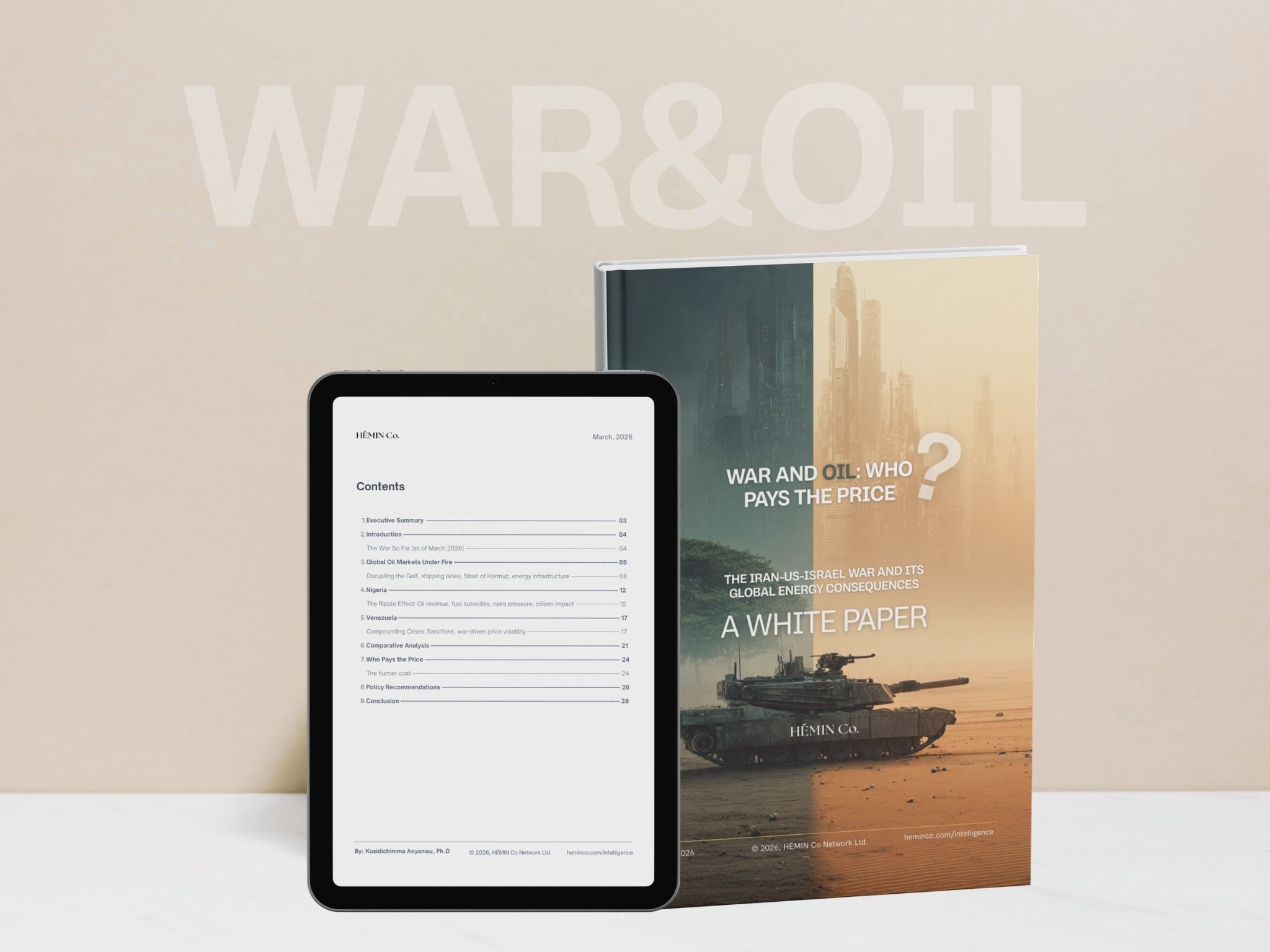
The war is reshaping the global economy. Fuel queues in Lagos. Empty shelves in Caracas, Venezuela. Download War and Oil: Who Pays the Price, a 30-page white paper that deep dives into the state of affairs.

DOWNLOAD REPORT

The US-Iran war that erupted on 28 February 2026. Launched under the codename Operation Epic Fury, it has rapidly become one of the most consequential geopolitical events of the decade. The Israel-Iran conflict has killed over 2,000 people, displaced hundreds of thousands across the Middle East, and triggered the largest oil supply disruption in the history of global energy markets.
At the centre of the crisis is the Strait of Hormuz, a narrow waterway through which roughly 20 percent of the world's daily oil supply normally flows. Iran's closure of the Strait has sent Brent crude oil prices surging from $70 to nearly $120 per barrel. The IRGC is threatening $200 oil if the conflict persists. The IEA emergency oil reserve release has offered only partial relief, with the largest in history at 400 million barrels.

But the oil price shock is not only a Middle Eastern story. Thousands of kilometres away, in Nigeria and Venezuela, ordinary citizens are paying a steep price for a war they had no part in starting.In Nigeria, the removal of the fuel subsidy has left pump prices fully exposed to global market forces. Petrol prices in Nigeria have surged from N880 to over N1,300 per litre in under a week, with diesel prices hitting N1,620 per litre.Meanwhile, the federal government's oil windfall raises urgent questions about whether revenues will reach those who need them most or simply disappear into debt servicing. The government had earlier in 2026 benchmarked the budget at $64.85 per barrel, which is now massively exceeded.

In Venezuela, the war has landed on a nation mid-collapse. With Nicolás Maduro arrested in January 2026 and a political transition still fragile, over 7.9 million Venezuelans require urgent humanitarian assistance. Venezuela's oil production, which is barely 1 million barrels per day despite the world's largest proven reserves, cannot capitalise on the price surge. The Venezuelan economic crisis continues to deepen, with 82 percent of citizens living in poverty.This white paper, "War and Oil: Who Pays the Price", traces the full chain of consequences from the Iran nuclear deal collapse and Khamenei's assassination to the global energy crisis of 2026. It examines what the Iran war oil prices mean for the developing world's most vulnerable oil-producing economies.

Read LessRead More

About the Author

Access HÉMIN Co. intelligence briefings

Request strategic insights delivery to your inbox

    Related Posts

    HÉMIN Co. designs narrative, insight, and systems with long-term intention. We operate globally, partnering with institutions, innovators, and cultural leaders shaping the next era of influence. Get connected.

    Find Us

    Stay Informed

    Request access to strategic insights right to your inbox

      Business Contact

      business@heminco.com

      Careers

      careers@heminco.com

      2026 Top Industries

      Sustainable Tech
      Artificial Intelligence
      Governance
      Oil & Gas
      Real Estate
      Insurance
      Pharmaceutical
      Entertainment
      lifestyle