

Designing Digital Systems for Institutions
Digital systems are no longer simply products. They are infrastructure for governance, knowledge, and cultural coordination. At HÉMIN Co., we design platforms, digital environments, and product ecosystems that allow institutions to operate with clarity, scale, and long-term resilience.
Our Approach
Our approach combines research discipline, narrative design, and systems architecture to produce digital environments that remain relevant beyond the lifespan of individual technologies.Every digital system begins with a question: What institutional problem must this platform solve? Technology is not the starting point. We begin by understanding structures, actors, incentives, and long-term governance. Our process unfolds across five phases.
A good understanding of a problem is the first step to any design process.
— UX Collective 2018
Sprint 1: Strategic Diagnosis
Before a digital system is imagined, the underlying institutional challenge must be clearly defined.We examine the structural forces shaping the project: What are the institutional objectives? How does the existing policy environment look? Who are the stakeholders within the ecosystems? What technological constraints exist or are probable? Any long-term governance considerations?The goal is to define what the platform must enable, not merely what it must display.
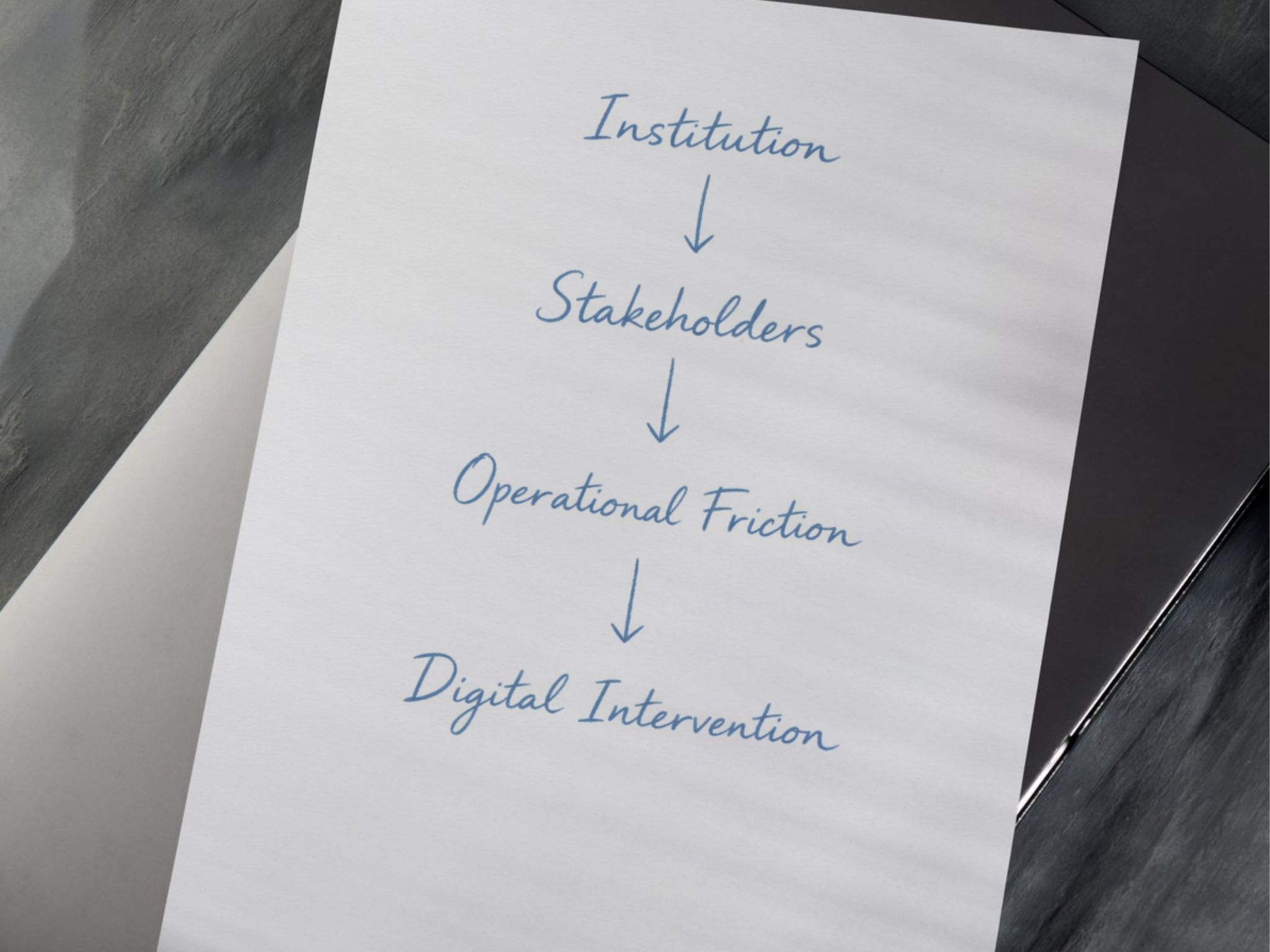
It's possible to be practical but also disruptive. Everybody wins, and any institutional innovation becomes anticipated
— Director at HEMIN Co.
Sprint 2: Institutional Mapping
Digital systems exist within networks of power, information, and decision-making.We map the institutional landscape to understand how the platform must interact with its environment. This includes: Clear understanding of stakeholder relationships. We align with decision flows. We also take into consideration information circulation structures, power structures, and public interfaces.The result is a structural map of the practically disruptive ecosystem the platform will inhabit.

The digital transformation won't happen overnight, the organizational structure optimization takes planning, experimenting, and scaling up.
— Pearl Zhu
Sprint 3: Systems Architecture
Once the institutional context is understood, the platform’s internal architecture is designed. This stage defines platform capabilities, data structures, content hierarchies, technical frameworks, and security and governance layers. The emphasis is not on interface aesthetics alone, but on how the system operates as infrastructure.

Modern structures must be flexible rather than rigidly hierarchical.
— Organisational thinking
Sprint 4: Interraction Narrative
Interfaces are not ordinarily, visual surfaces. They are narrative environments that guide how people understand and interact with information. At this stage we design critical elements of the platform. They include user experience frameworks, creative interface storytelling, data visualisation systems, editorial hierarchies, and interaction flows. The goal is to ensure the platform communicates clarity, authority, and purpose.
If you think good design is expensive, you should look at the cost of bad design.
— Dr. Ralf Speth, Chief Executive Officer, Jaguar Land Rover
Sprint 5: Deployment and Governance
A digital platform does not end at launch. Institutions require systems that remain functional and relevant over time. This phase ensures that important protocols are put in place including: Governance frameworks, editorial and content protocols, operational management systems, long-term scalability, and security and compliance. The result is a digital platform capable of operating as institutional infrastructure.
Case Study Application
Healthcare Industry